
(by Yuliasman Chaniago
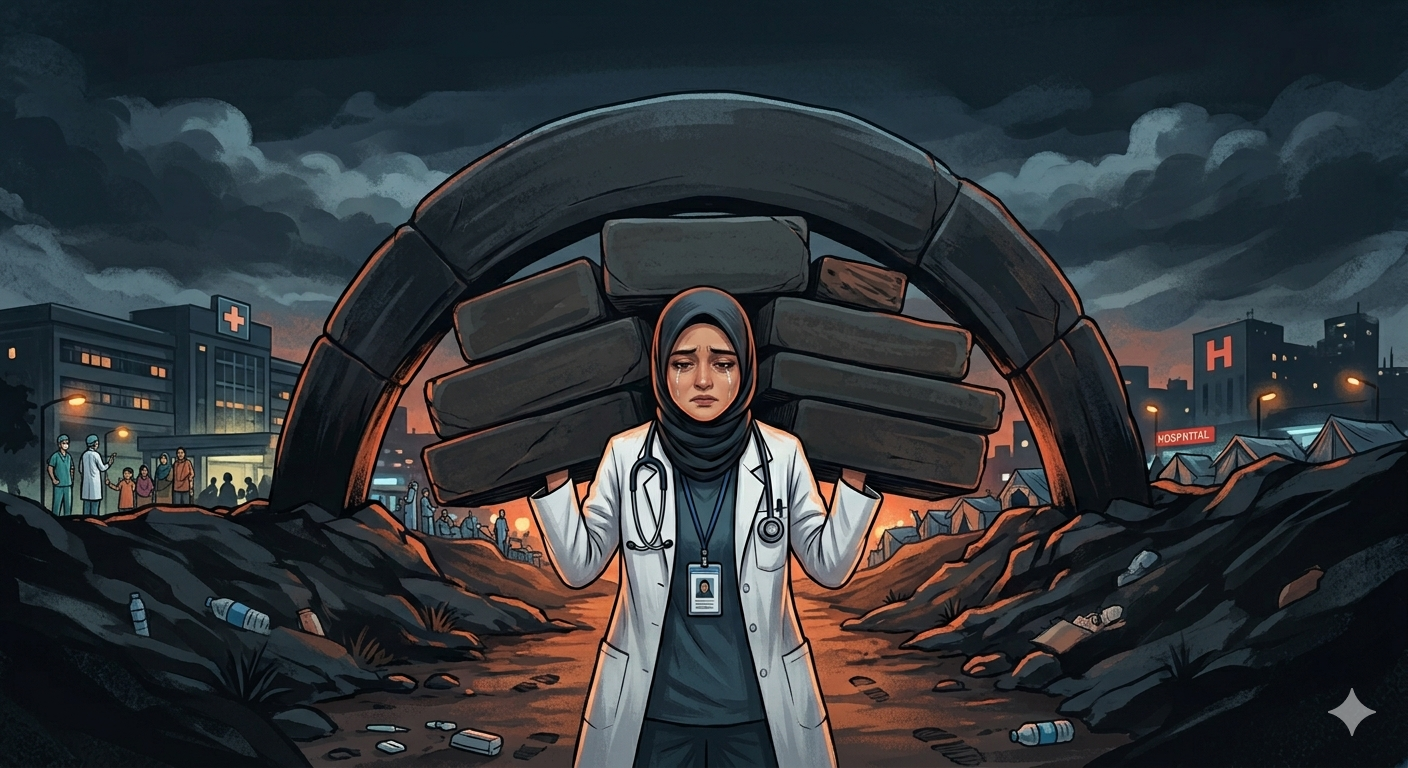
On May 1, 2026, dr. Myta Aprilia Azmy, a graduate of the Faculty of Medicine at Sriwijaya University, passed away in the ICU of Dr. Mohammad Hoesin General Hospital. Her oxygen saturation had dropped below 80 percent. She never lived to receive the certificate marking the completion of her medical internship program—the very gateway to her professional career.
For weeks, she had been working shifts in the emergency department of a regional hospital in Kuala Tungkal, Jambi, despite suffering from fever, coughing, and shortness of breath. She concealed her worsening condition from her supervising physicians, fearing she would burden her colleagues and risk an extension of her internship period.
dr. Myta’s story is not merely a personal tragedy. It is the intersection point of multiple systemic failures that have long been embedded within Indonesia’s healthcare governance. When the Indonesian Medical Association reported that at least four internship doctors had died since the beginning of 2026, and when the public discovered that Ministerial Regulation No. 13 of 2025 contained no clause limiting working hours, the issue ceased to be about individual negligence. The real question became: how deep does this governance failure run?
Governance Failure: Regulations on Paper, Breakdown in Reality
In public-sector governance frameworks, the International Federation of Accountants defines good governance as a system that ensures accountability, transparency, integrity, leadership, and responsible stewardship toward stakeholders. Measured against these standards, Indonesia’s Medical Internship Program (PIDI) exhibits severe deficits across nearly every dimension.
First, there is a multilayered accountability failure. The program involves at least four levels of authority: the Ministry of Health, provincial and district health offices, host hospitals, and supervising physicians. Yet even the Ministry’s own investigation found that supervisors were often absent. One participant reportedly complained, “We work every day, but our supervisor is never there.”
When responsibility is dispersed across multiple institutions without binding cross-verification mechanisms, what emerges is a vacuum of accountability. Every party assumes the issue belongs to someone else, while interns are trapped in the gaps between institutions.
Second, there is a regulatory paradox. Ministerial Regulation No. 13 of 2025 classifies internship doctors as “medical personnel,” implying entitlement to labor protection. Yet the same regulation sets no limits on working hours, mandates no workload audits, and provides no safe complaint mechanism for participants.
Health law scholar Rimawati from Gadjah Mada University described this condition as a “grey area”: interns are no longer students, yet not fully recognized as independent doctors. This ambiguity enables the system to maximize their utilization without extending equal protections. In legal theory, recognizing individuals as legal subjects while withholding the rights attached to that status constitutes structural discrimination.
Third, there is the criminalization of speaking up. On March 31, 2026, shortly after dr. Myta began showing symptoms, internship participants were summoned by supervisors to “discuss” criticism posted anonymously on social media and complaint platforms.
From a governance perspective, this represents institutional silencing—the obstruction of internal feedback channels that should function as essential early-warning systems. When whistleblowing is punished rather than protected, the collapse extends beyond individuals; the organization loses its ability to detect risks before they escalate.
Risk Management Failure: Known Risks, Ignored Warnings
International Organization for Standardization, through ISO 31000:2018, defines risk management as a coordinated process to direct and control organizations in relation to risk. Within the PIDI system, at least three fundamental failures stand out.
First, there was no ongoing health monitoring mechanism. Although dr. Myta underwent a medical check-up before beginning her internship and was declared fit, no periodic monitoring system existed afterward.
This represents a failure of preventive control. In high-risk industries such as aviation, mining, or nuclear power, continuous worker health monitoring is standard practice. Ironically, the sector responsible for restoring public health failed to protect the health of its own workforce.
Second, there was no workload audit mechanism. Reports indicate that dr. Myta alternated between 12-hour day shifts and 12-hour night shifts in the emergency department, allegedly working for three consecutive months without a day off.
Such conditions far exceed accepted safety thresholds. Studies by organizations such as the Sleep Foundation and the American College of Emergency Physicians consistently show that workloads exceeding 60 hours per week significantly increase medical errors and acute health risks. Yet the PIDI system imposed no binding workload audits on host hospitals, allowing exploitative practices to continue unchecked.
Third, the system demonstrated confirmation bias in its initial response. Before dr. Myta’s death, the Ministry’s Director General of Health Human Resources publicly stated that three previous internship doctor deaths were “unrelated to excessive workload.”
In risk management, this reflects normalcy bias—the tendency to underestimate risks whose consequences have not yet been formally acknowledged. In a healthy system, three deaths within the same program should have triggered a comprehensive investigation, not public reassurance.
Compliance Failure: Rules Without Enforcement
From a Governance, Risk, and Compliance (GRC) perspective, effective compliance is not merely the existence of regulations; it is the system’s ability to detect deviations and restore compliance promptly.
What unfolded within PIDI was compliance theater: regulations existed, supervision appeared to exist, yet control mechanisms were effectively absent.
Ministerial Regulation No. 13 of 2025 established no maximum working hours. Only after dr. Myta’s death—and under intense public pressure—did Health Minister Budi Gunadi Sadikin announce reforms on May 7, 2026, including a 40-hour workweek cap and expanded leave entitlements.
The Ministry also admitted that allowances and service incentives varied widely across regions, revealing the absence of enforceable minimum standards. Government support ranging from IDR 3 million to IDR 6.5 million per month was often insufficient even for basic living costs in many cities.
Importantly, the Indonesian Medical Association had already submitted reform recommendations to the Health Minister on April 27, 2026—before dr. Myta’s death. The warning signs existed. What was missing was institutional willingness to act before another life was lost.
In comprehensive compliance theory, regulations introduced only after public outrage are not evidence of governance success. They are evidence of governance failure. Reactive regulation responds to past tragedies instead of preventing future ones.
Sustainability Failure: A System Consuming Its Own Foundation
Beyond GRC, this tragedy carries profound sustainability implications. In Environmental, Social, and Governance (ESG) frameworks, the “Social” dimension includes labor protection, workplace safety, fair working conditions, and the prevention of exploitation.
Through the PIDI system, Indonesia’s healthcare sector has systematically violated these principles.
Indonesia already faces a severe doctor shortage. According to Ministry of Health data, the doctor-to-population ratio remains well below the World Health Organization standard of one doctor per 1,000 people. The internship program was designed partly to accelerate physician distribution to underserved regions.
Yet if the system itself damages the physical and mental health of young doctors—creating fear, chronic exhaustion, and institutional trauma—then it is sacrificing the nation’s long-term healthcare human capital for short-term operational efficiency. Such a trade-off is not only unethical; it is strategically self-destructive.
Even more damaging, the deaths of young doctors in service send a dangerous message to future generations: that becoming a doctor requires surrendering basic labor rights. If this perception persists, Indonesia risks not only losing doctors, but also losing the motivation of future generations to enter the profession at all.
The Iceberg Beneath the Surface
The deaths of dr. Myta and three other internship doctors between February and May 2026 represent only the visible tip of the iceberg.
Beneath the surface lie thousands of internship doctors enduring similar conditions: excessive workloads, absent supervision, inadequate allowances, and unsafe reporting environments. Most never become headlines because they survive. Yet psychological injury, burnout, and professional erosion do not simply disappear once internships end. They are carried into future medical practice.
In risk management theory, this is known as latent failure—hidden systemic weaknesses that remain unnoticed until conditions align to produce catastrophe. In his Swiss Cheese Model (1990), James Reason explained that disasters rarely result from a single major failure. They occur when multiple small weaknesses across different layers of defense align simultaneously.
Within PIDI, those holes were already present: regulations without working-hour limits, dysfunctional supervision, unequal compensation systems, punitive reporting cultures, and internship sites without workload audits. dr. Myta, tragically, stood at the point where all those failures converged.
The Ministry of Health’s recent reforms—40-hour workweek limits, expanded leave rights, and remuneration standardization—deserve recognition as emergency responses. But they are not enough.
What Indonesia needs is structural reform on at least three fronts:
- Independent and periodic workload audits for all internship hospitals, backed by firm administrative sanctions.
- A secure reporting mechanism for interns, protected from retaliation and equivalent to whistleblower protection systems in corporate governance.
- The integration of young doctors’ safety and welfare indicators into the hospital accreditation system managed by Hospital Accreditation Commission, ensuring that protecting junior medical personnel becomes an operational requirement rather than discretionary policy.
The death of dr. Myta Aprilia Azmy is a mirror Indonesia cannot afford to ignore.
She did not die from an incurable disease. She died within a system that failed to care enough to protect her—a system that knew problems existed, received warnings from the medical association, witnessed three previous deaths, and still failed to act with urgency.
That is the true disorder within Indonesia’s healthcare governance: not the absence of regulations, but the absence of institutional will to ensure those regulations work in practice, protecting the most vulnerable lives within the system itself.
No responses yet